


Chronic stress and the body: how long-term tension is hidden in physiology and how to notice it early


Have you ever wondered why, after a “regular” workday, your body feels like it’s run a marathon? Imagine a morning where you wake up without an alarm, your muscles relaxed, your head clear, and your energy surging. You smile at your reflection in the mirror because you feel alive.
Now comes reality. Constant fatigue, unexplained aches and pains, irritability. You think, “It’s age,” “It’s work,” “It’ll pass.” But it doesn’t. It’s chronic stress that accumulates in your body over the years, like an invisible poison.
This article is a bridge between your tired reality and a life without hidden burdens. We’ll explore where stress hides in your physiology, how to spot it in its early stages, and what to do to prevent it from deteriorating. And at the end… wait, that’s not all. You’ll get simple, actionable steps you can start tomorrow. Yes, you heard that right – stress-freedom is closer than you think.

Physiological “hiding places” of stress
Let’s face it: you know stress is bad. But do you know how deeply it penetrates your body? I promise: after this section, you’ll stop ignoring the signs. Let’s get started: we’ll explore the three main “hiding places” where stress can live for years.
- Hormonal chaos
The main player is cortisol. In acute situations, it saves the day: it speeds up reactions and provides energy. But with chronic stress, its levels go through the roof 24/7. What are the consequences?
- Fat accumulates in the belly (yes, it’s not just from the buns).
- Muscles are destroyed – the body “eats” itself.
- Immunity declines: colds, allergies, herpes – hello.
- The nervous system in survival mode
The brain switches to fight-or-flight mode, even when there’s no threat. The heart pounds, blood pressure spikes, and blood vessels constrict. Over time, this leads to hypertension and the risk of a heart attack.
- Inflammation at the cellular level
Stress triggers chronic inflammation. It doesn’t hurt like a wound, but it slowly destroys joints, blood vessels, and the brain. It’s like rust inside the body.
Let me explain it simply: your body is like a house with invisible cracks in the foundation. Everything looks beautiful on the outside, but inside, it’s crumbling. Now comes the most curious part: how does the body whisper for help before it screams?
Hormonal chaos
Cortisol rises → belly fat, immunity declines
Nervous system
Fight or flight mode → blood pressure rises, heart attack
Inflammation
Silent destruction of joints, blood vessels, and the brain
Early Signals: How the Body Whispers for Help
Did you know that 80% of doctor visits are stress-related? But people come with symptoms, not the cause. The body gives signals long before disaster strikes. Here’s a bullet point – check yourself:
- Fatigue “out of nowhere”: waking up feeling groggy, even after 9 hours of sleep.
- Tension headaches: like a band around your temple, especially in the evening.
- Digestion “fails”: bloating, heartburn, alternating between constipation and diarrhea – without changing your diet.
- Muscle tension: neck, shoulders, jaw – like a rock.
- Emotional swings: irritability → apathy → anxiety within 1 hour.
- Decreased libido: “other things” are becoming the norm.
If 3+ – Sign up for a consultation
Now I must make an important point: these symptoms are not a “habit.” They are an SOS. Ignore them, and you enter the chronic phase. And here’s the open loop: why don’t we notice the obvious? The answer is in the next section. But first… a consultation with a psychologist can be the first step to deciphering these signals. Don’t delay.

Why does stress disguise itself as the mundane?
The sad truth is: we’ve become accustomed to living with stress. “Everyone lives like this,” “It’s normal,” “I’m strong.” But it’s a trap. Evolutionarily, stress helped us survive on the savannah. Today, it’s killing us in the office.
Why are we blind to signals?
- Adaptation: the brain dulls sensitivity. Pain becomes background noise.
- Victim culture: “Without stress, there is no success” is a myth peddled by coaches.
- Psychosomatics: the body speaks, but we treat the symptoms, not the cause.
- Social pressure: admitting stress equals admitting weakness.
The thirst for health awakens when you realize that life without this burden is a reality. And now, the heart of the text. If you’re in the capital and want to figure things out quickly, an online psychologist in Kyiv is a format that saves time and nerves. No traffic, no waiting.
«We don’t notice stress because we allow it to become the norm. But the norm is not a death sentence.»
Closing the loop: yes, stress disguises itself because we allow it to. But there is a way out.

The Path to Liberation: Notice and Act
The joy of freedom: imagine yourself sleeping like a baby, waking up with energy, your body flexible, your thoughts clear. This isn’t a dream. It’s the result of conscious action.
5-step plan (start with any):
- Keep a body diary. Every evening:
- Where did it hurt?
- How did you sleep?
- What did you eat?
- How anxious are you (1-10)? You’ll see a pattern within a week.
- Breathing 4-7-8.
Inhale for 4 seconds → hold for 7 seconds → exhale for 8 seconds. 4 times in the morning, 4 times in the evening. Reduces cortisol by 23% in 2 weeks. - Movement without fanaticism.
30 minutes of walking a day. Not the gym – a walk. It breaks up muscle stagnation. - There is no border.
Learn to say no. One “no” a day = 10% less workload. - Professional support.
A psychologist isn’t for “crazy people.” It’s like a brain trainer. Especially if the signals are amplified.
Yes, you heard it right: catching it early means preventing a heart attack, depression, and burnout. This article is your guide. Start with one step. Tomorrow.
Live brightly. Without a hidden enemy.

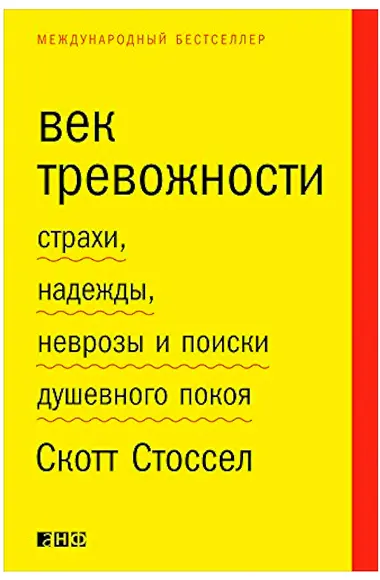
“The Age of Anxiety: Fears, Hopes, Neuroses, and the Search for Peace of Mind”
Scott Stossel’s book is a profound exploration of the nature of anxiety, one of the most common and paradoxical aspects of the human psyche. The author, a renowned American journalist and editor-in-chief of The Atlantic, doesn’t simply examine anxiety as a medical diagnosis, but rather reveals it as a cultural, historical, and personal phenomenon.
Within the book, he combines his personal experience of years of struggling with panic attacks and phobias with a broad panorama of scientific, philosophical, and literary perspectives on fear and anxiety – from antiquity to modern times. The reader will discover how anxiety shapes our civilization, art, politics, and even economics.
Stossel explores humanity’s attempts to understand and overcome anxiety – through religion, psychotherapy, pharmacology, and introspection. He explores the line between healthy anxiety and pathological fear, and why attempts to completely eliminate anxiety often prove illusory.
“The Age of Anxiety” is not just a popular science work, but the confession of a man who has learned to live with inner storms. This book is about finding peace of mind in an age where anxiety has become the backdrop of modern existence. It simultaneously comforts and inspires, reminding us that anxiety is not a weakness, but a part of human nature, from which empathy, creativity, and the power to change are born.


